Current Estimated Population of Los Angeles County
Estimate of people in LA county in areas with a shortage of doctors
Major Medical Schools (in Los Angeles County)
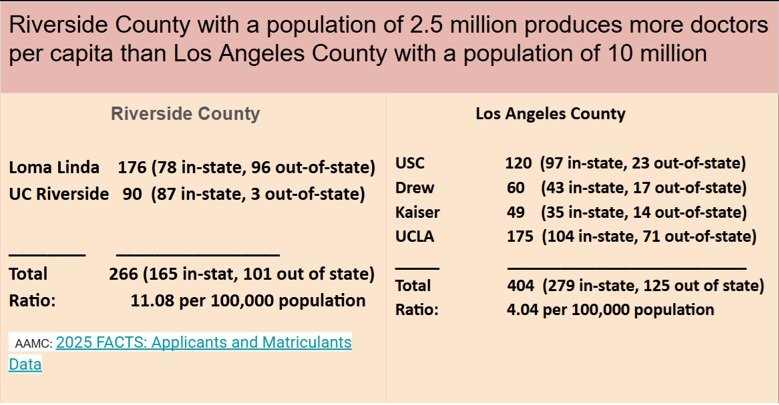
Los Angeles County
VS
o Nicaragua: 6.5 million: 6 medical schools
o Cuba: 11.4 million: 14 medical schools
o Sweden: 10.2 million: 8 medical school
o Illinois: 12.7 million: 8 medical schools
o Michigan: 9.9 million: 6 medical school
o Ohio: 11.6 million: 7 medical schools
o Pennsylvania: 12.8 million: 7 medical schools
o Massachusetts: 6.9 million: 4 medical schools
PROPOSAL
The following broad proposals are being offered as the dominant guiding culture to reshape the Los Angeles public health system based on the principle of "for the community, of the community, by the community".
The proposal would establish a new, independently operated medical school at Harbor–UCLA Medical Center in South Los Angeles, where UCLA no longer directly manages the county’s residency training programs*. The school would enroll 150 to 175 students annually. The mission is to train a diverse physician workforce to address doctor shortages and health disparities in low-socioeconomic communities. The curriculum will focus on preventative and primary care, including general internal medicine, pediatrics, family medicine, OB/GYN, and psychiatry. Students will be selected based on academic merit and ties to their communities. To ensure graduates serve in high-need areas, full scholarships and financial incentives will be offered to those who commit to five years of service in underserved communities after residency. Failure to meet this commitment will convert the scholarship into a repayable loan with interest. This model, which has been successful in areas like Riverside and Merced County, offers a viable, long-term solution to the chronic physician shortage in marginalized areas. The proposal to open a new medical school has been designed to ensure that the graduating physicians will have to serve the communities with Medi-Cal health insurance.
All county residency training programs should consolidate and be managed by the proposed new medical school. This would create a single, efficient workforce focused on providing primary and preventative care in underserved communities. Graduates of the new medical school would be given priority for selection into these residency programs. The goal is to train physicians who will serve the communities they came from.
The Associate Dean for postgraduate studies, in collaboration with the department chairs and division chiefs, will be responsible in structuring and designing innovative strategies to provide training based on the tradition of academic excellence in a safe and productive environment. Every measure will be taken to make sure that the training programs remain accredited and maintain compliance with the ACGME requirements.
The goal is to train physicians from the underserved areas to serve in their own communities where they grew up. The emphasis on the residency training programs would be on primary and preventive care and to head off chronic diseases and expensive hospitalization. All supervising physicians will have to maintain an academic position at the proposed new medical school and will have to be in good standing.
Any lapses in implementing training policies will be swiftly investigated and effectively dealt with by the academic senate. This will ensure the principles of accountability and transparency. This way the county will be able to concentrate on delivery of care and will have virtually no legal liabilities.
Consolidation of resources will create a stronger, united, and more effective institution. The current system that divides the four teaching hospitals of Los Angeles County has created two distinct, fragmented health care and teaching systems lacking collaboration.
The proposal suggests expanding the Los Angeles County College of Nursing and Allied Health to address healthcare workforce shortages, including in maternal care. Nurses will receive their clinical training alongside medical students and residents in county community clinics. Efforts will be made to recruit these graduates to work in county clinics, where they can utilize their skills in team-based and emerging technologies like “Tele Paramedicine” to expand telehealth access for underserved populations.
A key addition will be a new midwifery training program, which will be developed in collaboration with the county’s OB/GYN residency programs. This is a direct response to the significant maternal and infant health inequities in marginalized communities. Los Angeles county has a disproportionately low number of midwives, with only 17 per 10,000 births compared to the state average of 30 and the Bay Area’s 55 (CHCF, September 2024). Training more midwives will provide a cost-effective solution to improve pregnancy, childbirth, and postpartum outcomes and help lower the high maternal mortality rates in
these communities.
The County should consider establishing a Graduate School of Public Health which would enhance the proper study of population medicine and the demographics within the County. Addressing health disparities requires first collecting demographic data and conducting population research to understand the unique needs of each community and guide prevention efforts. The proposed School of Public Health will examine the factors driving chronic diseases, gaps in life expectancy, and barriers to quality of life. By building this evidence base, the School will recommend the most effective and equitable uses of taxpayer resources, ensuring investment target programs that reduce disparities in case and improve
outcomes for the County’s diverse populations.
In addition, the school will analyze disease patterns, aging, and mental health, while addressing urgent issues such as smoking, domestic abuse, crime, housing, environmental risks, opioid addiction, and gun violence. It will also explore how emerging technologies can promote prevention and expand access to care. These efforts will guide practical public health strategies that reduce inequalities and make sure resources are used wisely and directed where they are needed the most, especially as federal support for vulnerable communities remains uncertain.
Closing the digital divide through investments in telehealth and para-telehealth offers a cost-effective way to expand equitable access to medical and mental health services, and reduce the strain on emergency departments while lowering overall health care costs. These technologies improve helah outcomes through tools such as virtual consultations, remote monitoring, and streamlined appointment systems, and they are especially valuable for populations that experience the greatest barriers to in care, including people of color, individuals with disabilities, and those experiencing homelessness, and incarcerated individuals. Beyond direct patient care services, telehealth also supports population health research, enhances post-graduate training, broadens access to continuing education, and strengthens community engagement, and much more.
In 2015, the County Supervisors approved consolidating the three health-related departments, DHS, DMH, and DPH, to improve health outcomes for residents. Nearly a decade later, this process is ongoing. The proposed medical school to address the shortage of physicians, along with consolidating County postgraduate residency programs, aligns with this effort. With the implementation of the CalAIM system to better coordinate physical, behavioral, and social services for Medi-Cal patients, there is now an opportunity to integrate the Department of Public Social Services with the other health departments.
Most patients in County facilities are Medi-Cal recipients who also rely on DPSS for housing, food, financial support, and other social services. Many face poverty, unemployment, substance use, domestic violence, serious mental illness, or limited knowledge of available resources. Integrating DPSS would streamline care, reduce duplication, and eliminate bureaucratic barriers, allowing patients to access both medical and social support in a coordinated system. This approach would improve health outcomes, enhance quality of life, and reduce costs through more efficient use of resources.
Download the full proposal here:
News

Reform LA Health hosts forum to advocate for building new medical school
Daily Bruin
The physician shortage behind the health care divide
Mar Vista Voice
What are the early and delayed health impacts of smoke exposure due to the Lineage Fire?
Calo News
More people in healthcare are learning Spanish. The demand is still higher
Calo News
Spectrum News 1: Health care & transit challenges in lower income communities
Spectrum NewsUCLA dermatologist leads initiative to address disparities in LA health care
Daily Bruin
Can Measure ER counteract the lack of federal funding for healthcare?
Calo News
An LA County doctor has a plan to get more doctors into local health care deserts
KNX NewsThe issues facing the LA County Health System
Impacts of Physician Shortages

The number of physicians in many low socioeconomic communities in LA county is below the recommended ratio. The communities with severe shortage of doctors and lack access to care were disproportionately affected by the Coronavirus. Health inequities has led to higher morbidity/mortality rates amongst African Americans, Latinx, and other low-income communities making them more vulnerable to infections, cancer, diabetes, heart disease, and higher infant/maternal mortality rates. They face significant disadvantage for early detection, delay in care and live a shorter life span (75 yrs) as compared to residents of affluent communities (90 yrs). An estimated 3,702,746 people in the county live in areas with shortage of doctors.
L.A. County with a population of more than 10 million has only two major medical schools whereas Costa Rica with a population of 4.25 million has 7 medical schools.LA County should establish a new medical school to train the much-needed physicians and waive tuition for graduating doctors who commit to serve in areas with shortage of physicians. This will present a viable solution to shortage of physicians and improves access to care in low socioeconomic communities and ultimately will save lives. Given the current healthcare crisis, while the time has come to address the inefficiencies of the LA County Department of Health Services, there is greater need for a better and stronger healthcare system across the county. Now is the time to act, and please join us in making this more widely known.
